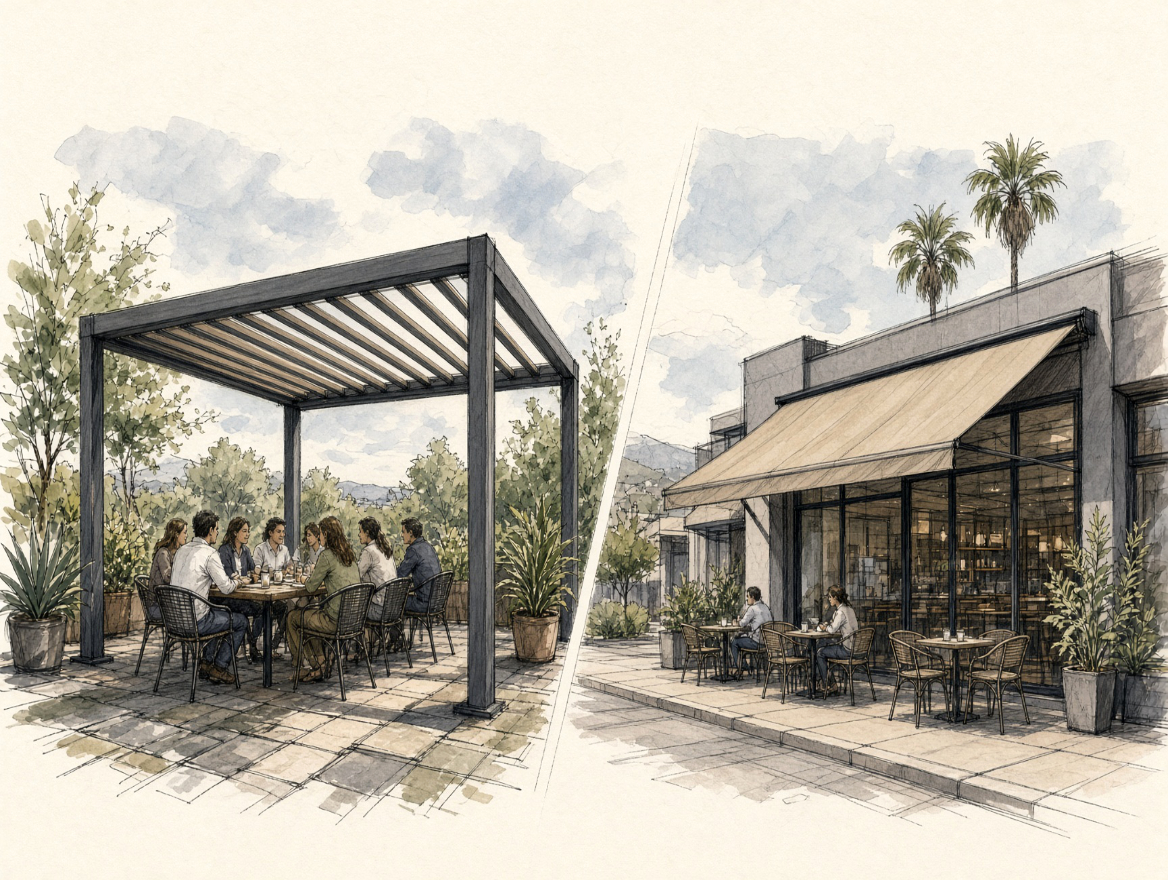
Audience: Commercial restaurant operators (hotels, wineries, clubs, retail outdoor seating)
Should your patio get a louvered pergola or a retractable awning? For most restaurant operators, the answer turns on rain, wind, permits, and how many months you need those seats to stay sellable.
Goodwin-Cole provides and installs commercial pergolas and commercial retractable awnings for restaurants, hotels, and other hospitality sites across California. This guide compares the two systems the way an owner or GM decides: Can guests stay seated when weather turns? What should staff do in wind mid-service? What do the building and the city allow? There is no single winner, only a better fit for your patio.
Commercial patio projects are almost always unique. Request a site assessment and a project-specific quote.
Quick comparison
| Motorized louvered pergola | Commercial retractable awning | |
|---|---|---|
| Structure | Permanent aluminum frame with adjustable roof louvers | Fabric canopy on folding arms; retracts into a housing |
| Shade control | Louvers open, tilt, or close | Extend for shade; retract for open sky |
| Rain | Fully closed louvers form a watertight shelter (Goodwin-Cole commercial pergola page) | Water-resistant fabric; rain sensors available—still not a sealed roof |
| Wind | Frame stays; follow manufacturer blade guidance | Wind sensors can auto-retract; follow manufacturer limits |
| Open sky | Partial when open (blades overhead); some systems fully retract louvers | Full open sky when retracted |
| Typical mount | Freestanding, wall-mounted, or cantilever | Wall-, roof-, or soffit-mounted |
| Permit/site work | Footings and engineering more common when freestanding | Needs a suitable mount; sidewalk / outdoor-dining review may still apply |
| Best-fit patio | Year-round outdoor dining room | Flexible warm-season shade on a building-attached strip |
What each system actually is: Motorized louvered pergola
A commercial louvered pergola is a permanent outdoor structure with adjustable aluminum roof slats. The louvers rotate to control sun, airflow, and shelter. Goodwin-Cole’s commercial pergolas are positioned for restaurants and hotels that need adaptable outdoor seating with weather cover when the louvers are closed.
Closed louvers can form a strong rain shelter when water is shed into hidden gutters and channeled through the frame and posts. That controlled drainage is what makes a closed louvered roof useful in ordinary showers. It is not a promise of absolute waterproofing. Manufacturer guidance for louvered outdoor-living systems commonly states that the structure is highly water-repellent yet not fully watertight like a conservatory, that wind can drive rain under the roof, and that extreme downpours can overwhelm gutters. See Brustor’s public overview of protection from wind and rain and its Outdoor Living sales and warranty conditions PDF for documented drainage and waterproofing language on specific Outdoor Living models.
Mounting options on the Goodwin-Cole commercial pergola page include freestanding posts and footings, wall-mounted ties into the building, and cantilever or roof-mounted spans that keep posts out of walkways. Related options include retractable louvered roofs, fabric or panel roofs, insulated roofs, and side treatments such as clear vinyl window enclosures, outdoor curtains, and roller shades. See the commercial pergola gallery.
Commercial retractable awning
A commercial retractable awning is a fabric canopy that extends for shade and retracts when you want open sky or when weather requires it. Goodwin-Cole’s commercial retractable awnings are aimed at restaurants, cafes, retail, and hotels. They mount to a wall, roof, or soffit, so they need a solid building edge more than a freestanding field of posts.
Operation options include manual crank for smaller cafes or limited power, and motorized control by remote, wall switch, or app for larger awnings and busy restaurants. Optional sun, wind, and rain sensors can automate movement. Accessories often include drop-down valances, integrated LED lighting, and infrared heaters. Commercial fabrics typically include solution-dyed acrylics with UPF 50+ and water resistance. Browse examples in the retractable awning gallery.
Retractable awnings are sun-shade systems. They are not designed as rain roofs. Brustor’s public accessory and weather pages state that when wind rises or the first raindrops fall, the awning closes automatically, and its end-consumer sun-protection warranty conditions instruct operators to close solar shading in rain, wind, snow, and hail, with an optional rain sensor that rolls the shading up. Sensors are not an absolute guarantee.
Sources: Brustor awning accessories, protection from wind and rain, and the Sun Protection Warranty conditions PDF.
Not the same as a fixed awning, shade sail, or umbrella
This comparison covers only louvered pergolas and retractable awnings. Fixed storefront cover, shade sails, and commercial umbrellas solve different problems. If you need permanent storefront cover, see commercial fixed awnings.
Rain: can guests stay seated?
If the job is keeping seats sellable when a shower hits, a closed motorized louvered roof is the stronger overhead answer. Closed louvers shed water into hidden gutters that run through the frame and posts, so guests can often stay seated through ordinary rain when the roof is closed and drainage is clear.
That still is not absolute waterproofing. Heavy downpours can overwhelm gutters. Wind can drive rain sideways under the roof. Side screens or walls may still be needed. After rain, opening louvers can release residual drips. Follow the manual for the exact model on your patio.
A retractable awning should be retracted in rain. Water-resistant fabric helps the canopy itself, but an extended fabric awning is not a sealed dining roof. Plan retractable systems for sun control and clear wet-weather rules: bring the awning in, move guests, or rely on a different structure.
Wind: what staff should do mid-service:
Retractable awnings
When wind rises, retract the awning. Do not treat a catalog wind-class number as the moment it is still safe to keep serving under an extended canopy.
Brustor’s published sun-protection warranty conditions state that its solar-shading products are CE wind class 2 under European standard EN 13561, corresponding to Beaufort 5, maximum 38 km/h about 24 mph. That figure is a classification rating for the product family, not a green-light threshold for restaurant operations. Retract earlier whenever your exact model manual, site exposure, or gusty conditions call for it. Optional wind sensors can close folding-arm awnings automatically above a set threshold, yet Brustor notes that a wind sensor does not provide an absolute guarantee, especially in sudden gusts. Floor teams still need a mid-service rule for when the awning comes in.
Arm options and site ratings also vary by model. Follow the dealer documentation for the awning installed on your patio.
Louvered pergolas
The pergola frame stays put while louvers rotate. Do not assume that fully closed or fully open is always safer in high wind. Blade position depends on the model and the weather condition, and precautions should start well before extreme events.
Brustor’s Outdoor Living sales and warranty conditions illustrate how model-specific the guidance is. On named Outdoor Living models such as B160XL, B200, B200XL, B600S, and B720, an optional rain sensor closes the roof by rotating louvers fully horizontal. For snow on those louvered models, the same document calls for rotating louvers to a fully vertical position. It further states that the supporting structure with closed louvers is guaranteed to withstand wind speeds up to 100 km/h about 62 mph, and that above 100 km/h the louvers of types B160XL, B200, B200XL, B250XL, and B720 must be set at an opening angle of 30 to 45 degrees, while B600S louvers must be fully stacked. Those extreme-wind positions are manufacturer limits for specific models, not instructions to wait until conditions are already severe before acting. Use your installer’s model sheet and take action at the thresholds your manual and local site conditions require.
Document caveat: those Outdoor Living figures come from Brustor’s published warranty conditions for listed European Outdoor Living models and CE classifications. They are evidence of manufacturer practice, not a claim that every California restaurant install is one of those exact models, and not a guarantee for every site. Source: Outdoor Living sales and warranty conditions PDF.
For Northern California wind context on engineered outdoor shade, see Goodwin-Cole’s Shade That Stands.
Year-round seating and guest experience
Choose a motorized louvered pergola when you want a permanent outdoor dining room: filtered light at brunch, closed louvers when weather turns, and a longer outdoor season. Lighting and side weather options can extend evening and shoulder-season use.
Choose a commercial retractable awning when the patio is building-attached, open sky matters as much as shade, or coverage should disappear after service. Motorized control fits busy floors. Manual crank still fits small cafes or limited power.
Heaters and LED lighting can support evening service on either path when specified correctly. Mounting clearances, electrical work, and fire rules vary by product and jurisdiction. Use the heater manufacturer’s installation instructions and confirm requirements with your local fire authority before ordering. For rough outdoor-dining capacity planning, Goodwin-Cole’s outdoor dining opportunity calculator is a useful worksheet before you request a site assessment.
Permits, posts, and the building
Commercial outdoor shade often needs more than a product choice. Rules vary by city and by whether seating sits on private property or the public sidewalk.
Wall-mounted retractable awnings need a suitable mounting surface and clear headroom, doors, signage, and egress. Building permits and outdoor-dining or encroachment reviews may apply, especially on sidewalk cafe strips. Do not assume fabric means no review.
Freestanding or heavily posted pergolas more often need engineered footings and a building permit. That is part of why a pergola behaves like an outdoor room.
Where servers, accessibility routes, or sightlines matter, cantilever and roof-mounted pergola options can extend shade without posts in the circulation path. Call that out early in design.
Confirm requirements with your local building and planning departments. Goodwin-Cole’s partnerships page notes experience with construction timelines, permitting processes, specifications, submittals, and shop drawings when projects need that coordination.
Decision guide
Choose a retractable awning when:
- Seating attaches to a wall, roof edge, or soffit
- You want full open sky when the canopy is retracted
- Warm-season sun control is the main job
- Staff can retract for wind and rain
- You want a lower-complexity start for storefront or sidewalk seating, after confirming permits
Choose a motorized louvered pergola when:
- You need a permanent outdoor dining room, not only a shade panel
- Rain interruptions are costing seat-turns and you want a closed louvered roof with frame drainage
- The patio is freestanding or too deep for a practical awning projection
- Lights, side weather protection, or a multi-season concept are in the plan from day one
- Brand and architecture call for a framed outdoor room
Hybrid layouts: Some properties use retractables on the storefront strip and a louvered pergola on a rear or courtyard terrace. Ask for that option when you request a project-specific quote if your site has more than one outdoor zone.
California operator notes
Goodwin-Cole serves California. Plan commercial patio shade for three stresses: intense summer sun, gusty wind, and winter rain. Walk the patio at the hours you actually seat guests. West glare at late afternoon is not the same problem as noon shade. Note mounting walls, utilities, footing access, and any tables in the public right-of-way.
When you are ready for numbers tied to your seats and hours, use the outdoor dining calculator, then request a site assessment and project-specific quote.
How Goodwin-Cole helps
Goodwin-Cole is a California company that provides and installs commercial pergolas and retractable awnings, so the recommendation can follow the patio rather than a single product line. Learn more on Our Story.
Request a site assessment and project-specific quote through Contact Us or call 916-381-8888.
FAQ:
Should our restaurant patio get a louvered pergola or a retractable awning?
Choose a motorized louvered pergola when you want a permanent outdoor dining room with louvers that open for sun and air and close into a drained rain shelter. Choose a commercial retractable awning when you want flexible sun shade on a wall-, roof-, or soffit-mounted patio strip that can disappear for open sky or when wind and rain require retraction. Decide by how many months you must sell those seats, whether you have a solid mounting wall, and how often rain or wind interrupts service.
Which is better in rain and wind?
A closed motorized louvered roof is the stronger weather shelter for rain because water drains through integrated gutters in the frame, without claiming absolute waterproofing. A retractable awning is a sun-shade system and should be retracted in rain and rising wind. Optional sensors can automate that retraction, but they are not a substitute for staff rules or the exact model manual. Louver blade position in high wind is model-specific; do not assume closed or open is always safer, and do not wait for extreme conditions before taking precautions.
Do restaurant patios need a permit for these systems?
Often yes for commercial work. The path depends on the city, whether the system attaches to the building or needs footings, and whether seating is on private property or the public sidewalk. Confirm with your local building and planning departments.
Do we need a wall to mount a retractable awning?
Usually yes. Commercial retractables are typically wall-, roof-, or soffit-mounted. A freestanding terrace without a suitable building edge is often a better fit for a freestanding pergola.
Can we add heaters, lights, or side screens later?
Often yes when planned correctly. Retractable awnings can include LED lighting, infrared heaters, and drop-down valances. Pergolas can include lighting and side weather options. Follow the product manufacturer’s clearance instructions and confirm fire and electrical requirements with local authorities before you order.
When is a retractable awning enough?
When the main job is sun control on a building-attached patio, staff can manage retraction for wind and rain, and you accept that wet weather ends outdoor service under that canopy. If empty wet tables already hurt the P&L, evaluate a louvered pergola or a hybrid layout.
Can we use both on one property?
Yes, when the site has different zones, such as a storefront strip and a courtyard terrace. Ask for a hybrid layout when you request a project-specific quote.
